

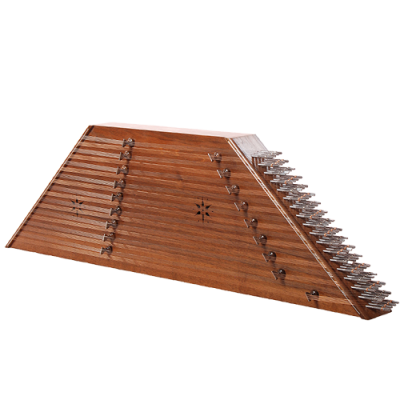
The Santur is played with two thin wooden sticks called mezrabs (or mallets). In the past, the mezrabs were used without felt coverings, but today, most players attach small pieces of felt to their tips. This addition softens the tone and reduces the metallic resonance of the instrument’s sound. In most cases, the performer must strike different notes with each mezrab, which requires not only agile hands but also strong mental concentration—something that can only be achieved through extensive practice. The Santur is an instrument that, when mastered, allows the musician to create beautiful and enduring works. The instrument is well-suited for both solo and ensemble performances. However, nearly half of a Santur player’s life is spent tuning the instrument. Continuous striking of the strings with the mezrabs, combined with the effects of humidity and temperature on the wood and strings, easily throws the tuning out of balance. With its seventy-two strings that must constantly be tuned to match, the Santur is known as an instrument of both great beauty and great sensitivity—its sound and tuning can be affected by even the slightest physical changes, often challenging even the most skilled musicians to achieve their ideal tuning.